
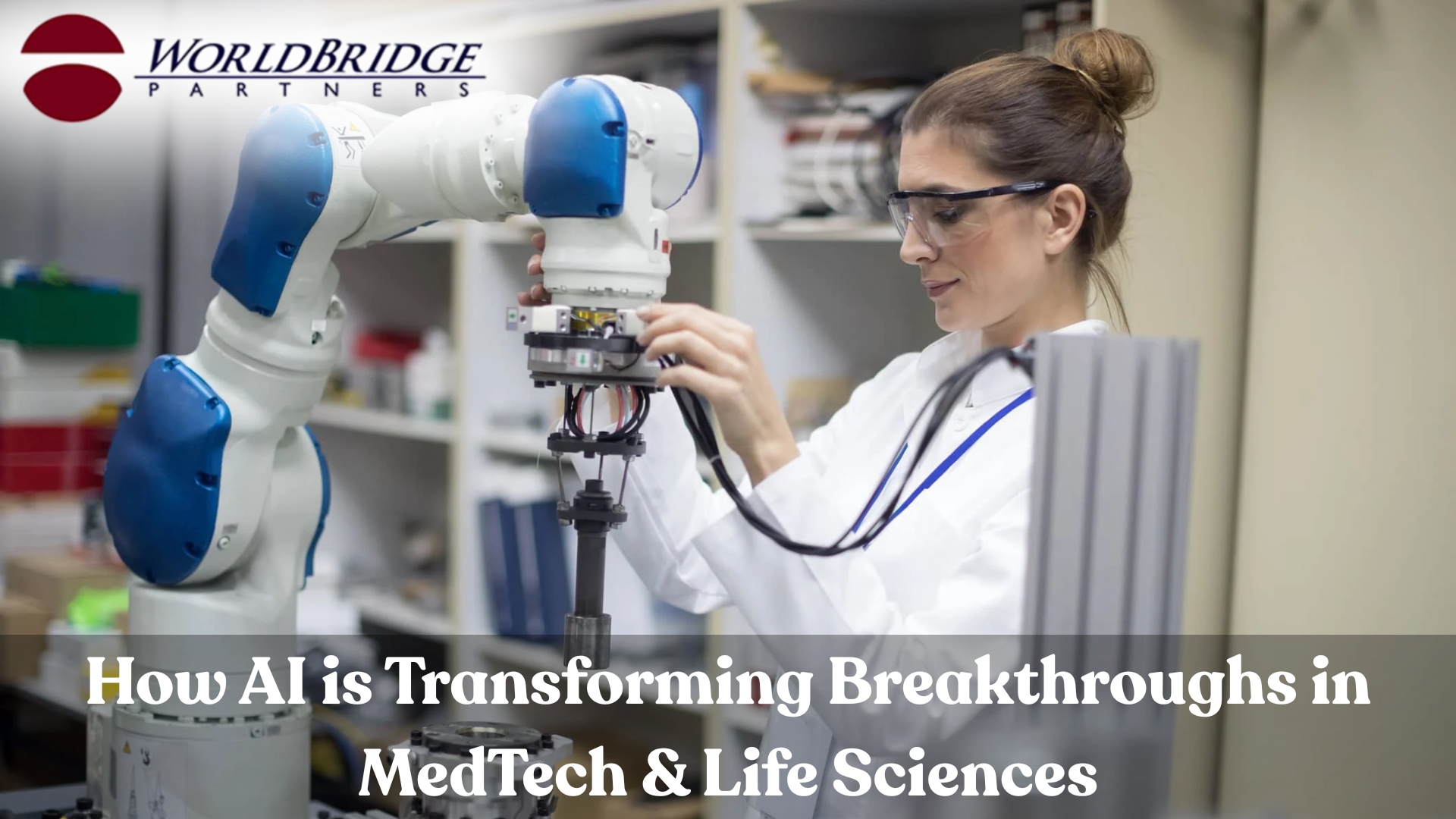
How AI is Transforming Breakthroughs in MedTech & Life Sciences
Introduction
Artificial Intelligence (AI) is no longer just a supporting tool in healthcare—it is now a driving force behind the most significant breakthroughs in medical technology (MedTech) and Life Sciences. From accelerating drug discovery to enabling precision medicine and revolutionizing medical device innovation, AI is shaping a future where patient care is faster, more accurate, and more accessible.
- Accelerating Drug Discovery and Development
Traditional drug discovery takes years of research and billions of dollars in investment. AI dramatically shortens this cycle by analysing vast biological datasets, predicting molecular interactions, and identifying promising drug candidates in a fraction of the time. Pharmaceutical companies are utilizing AI models to simulate clinical outcomes, thereby reducing trial costs and enhancing success rates. This acceleration is especially vital in areas such as oncology, neurology, and rare diseases, where time is critical.
- Advancing Precision Medicine
AI empowers life sciences researchers to tailor treatments to individual patients. By processing genomic data, electronic health records, and imaging results, AI systems identify genetic markers and disease patterns that traditional analysis might miss. This enables clinicians to develop highly personalized treatment plans—whether in cancer therapies, gene editing, or the treatment of rare genetic disorders—resulting in better outcomes and fewer adverse effects.
- Transforming Medical Imaging and Diagnostics
Medical imaging is one of the most visible areas where AI is making an impact. Machine learning algorithms can analyse X-rays, CT scans, and MRIs with precision that rivals or even surpasses that of human specialists. In radiology, pathology, and cardiology, AI-powered diagnostic tools detect anomalies earlier and with higher accuracy. For example, AI helps identify tumors at their earliest stages or predict the likelihood of cardiovascular events, enabling timely intervention and saving lives.
- Enhancing Medical Devices and Wearable Technologies
In the MedTech sector, AI is driving innovation in innovative medical devices and wearable health technologies. Devices equipped with AI can monitor vital signs in real time, detect irregularities such as arrhythmias, and alert both patients and physicians instantly. Beyond monitoring, AI-enabled implants and surgical robotics are advancing minimally invasive procedures, improving precision, and reducing recovery times. These advancements are transforming the way patients engage with technology for ongoing care and wellness.
- Revolutionizing Clinical Trials
Recruitment challenges, data inconsistencies, and long monitoring phases often slow clinical trials. AI streamlines the process by identifying suitable candidates, predicting patient adherence, and analysing trial data in real time. Virtual trials, powered by AI and digital health platforms, are becoming increasingly common, improving accessibility for participants across different geographies while reducing costs for life sciences companies.
- Unlocking Genomics and Bioinformatics
AI has become essential in analysing massive genomic datasets. Machine learning algorithms decode complex genetic information, revealing insights into disease mechanisms and potential therapeutic targets. In the life sciences, AI-driven bioinformatics platforms are accelerating breakthroughs in areas such as CRISPR gene editing, regenerative medicine, and synthetic biology, pushing the boundaries of what is scientifically possible.
- Improving Patient Engagement and Outcomes
AI also enhances the patient experience. Chatbots and virtual health assistants provide continuous support, answering medical queries, scheduling appointments, and offering medication reminders. In chronic disease management, AI systems track patient progress and suggest personalized interventions, helping patients stay engaged in their care journey and improving long-term health outcomes.
- Ethical and Regulatory Considerations
As AI continues to transform the MedTech and Life Sciences sectors, challenges remain. Issues such as data privacy, algorithmic bias, and regulatory compliance require careful governance. The industry is moving toward transparent, explainable AI models that meet strict ethical standards while ensuring patient trust. Collaborative efforts between regulators, providers, and technology developers will be key to unlocking AI’s full potential safely.
Conclusion
AI is revolutionizing MedTech and Life Sciences, driving faster drug discovery, more accurate diagnostics, and personalized care strategies that were unimaginable a decade ago. By integrating AI into research, development, and patient care, the industry is not only improving efficiency but also transforming the quality of life for millions worldwide. The future of healthcare is not just digital—it is intelligent, data-driven, and profoundly human-centered.