Introduction Artificial Intelligence (AI) is no longer just an emerging technology—it has become a driving…
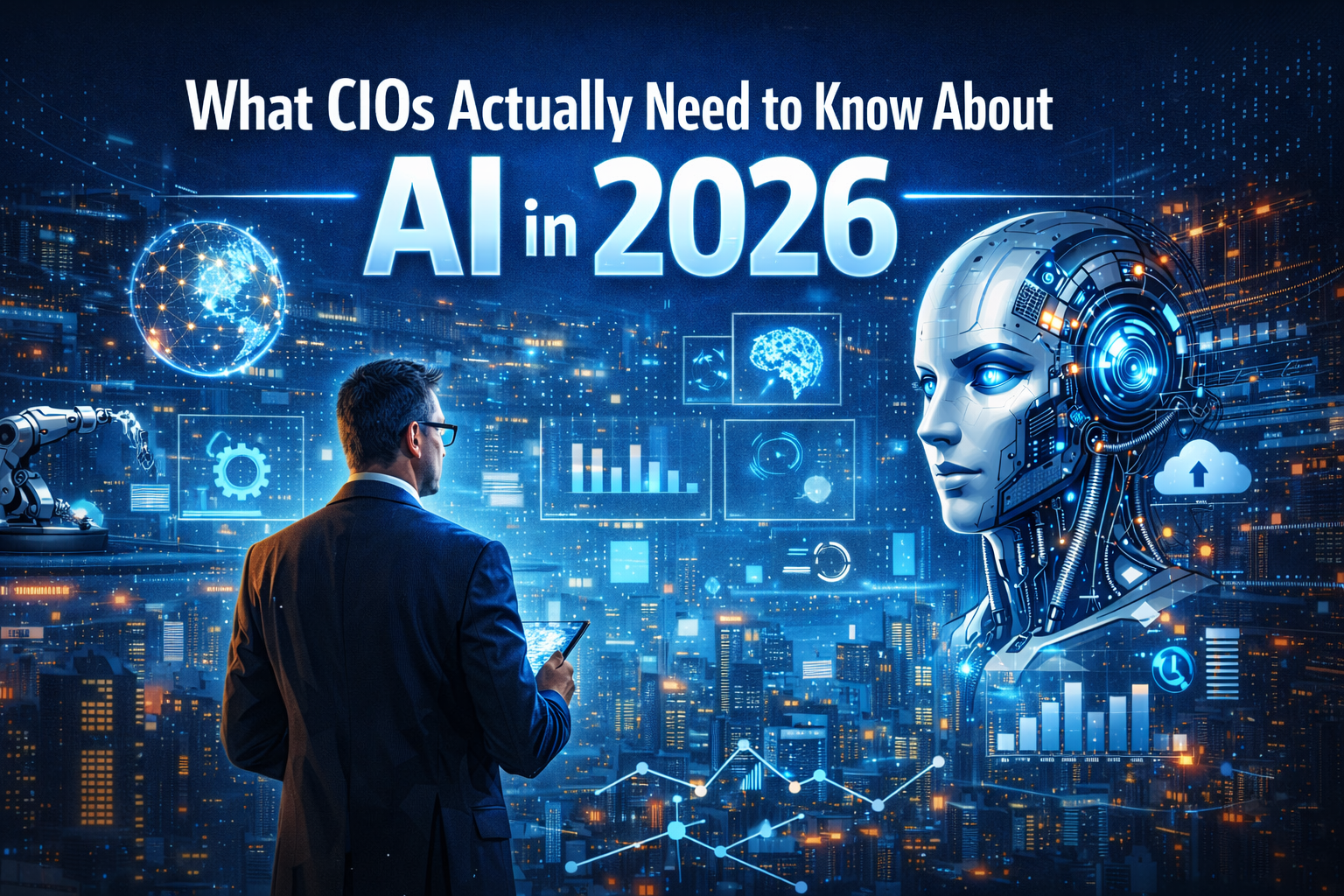
What CIOs Actually Need to Know About AI in 2026
Insights from 20+ Years Leading a Northern California CIO Peer Group
By Dave Sanders, Managing Partner, WorldBridge Partners
For over 20 years, I’ve facilitated a CIO peer group in Northern California with approximately 60 participating companies meeting nine times per year. These sessions have always surfaced the real challenges technology leaders face – not the polished narratives you read in trade publications, but the messy, pragmatic realities of running IT in growth companies.
Lately, every meeting starts the same way: someone asks, “Where do we even start with AI?”
The pressure is undeniable. Boards are demanding AI strategy. CEOs want cost savings and competitive advantage. Consultants are pitching transformation roadmaps. But after two decades of listening to CIOs navigate technology shifts – from cloud migration to digital transformation to cybersecurity – what I’m hearing now feels different.
Here’s what’s actually happening on the ground.
The Data Problem Is Bigger Than the AI Problem
The most common misconception I hear from boards and CEOs is that AI is primarily a technology procurement decision. Buy the right tools, hire a few data scientists, and results follow.
The CIOs in our group know better.
You can’t automate workflows with AI if your data is scattered across twelve systems, half of it inconsistent, and nobody owns data quality. The AI models don’t care how sophisticated they are – garbage in, garbage out still applies.
The CIOs getting real traction aren’t the ones chasing the latest large language models or recruiting for “AI expertise.” They’re the ones who spent the last two years building data foundations: unified data lakes, clear ownership, governance frameworks, and most critically – executive sponsorship for data quality as a strategic priority.
One CIO in our group, leading technology for a 400-person SaaS company, put it bluntly during a recent meeting: “I can’t sell the board on another six-month data governance project, but that’s exactly what we need before any of this AI stuff actually works. So we’re doing it under the radar and calling it ‘AI readiness infrastructure.'”
That’s the reality. The flashy AI demos work in controlled environments. Production AI requires foundational work that doesn’t photograph well for board decks.
Nobody Knows Which Workflows to Automate First
The second pattern I’m seeing across our nine annual meetings: analysis paralysis.
Every CIO is being asked, “What’s our AI strategy?” But the real question underneath is: “Which workflows should we automate first, and how do we know we’re not wasting money?”
Customer support automation? Finance and accounting workflows? IT operations? Code generation for developers? Predictive analytics for sales?
The options are endless. The budget is not.
The CIOs I see making measurable progress aren’t the ones with the most comprehensive AI strategies. They’re the ones who are ruthlessly focused on workflows where:
- The ROI is measurable in months, not years. If you can’t show concrete cost savings or revenue impact within two quarters, it’s probably the wrong starting point.
- There’s executive sponsorship beyond just IT. AI initiatives that live entirely inside IT tend to die there. The successful ones have a business owner who’s equally invested in the outcome.
- Failure won’t break something critical. Start with workflows where if the AI doesn’t work perfectly, the business doesn’t grind to a halt while you iterate.
One mid-market CFO software company in our group started with automating their tier-one customer support inquiries. Not because it was the most transformative use case, but because it was contained, measurable, and had a champion in their VP of Customer Success. Six months later, they’re seeing 34% ticket deflection and expanding from there.
Contrast that with another company that tried to boil the ocean – launching AI initiatives across five departments simultaneously. Eighteen months later, they’ve spent over a million dollars and have little to show for it beyond proof of concepts that never made it to production.
The CIO Role Is Shifting – And Fast
Here’s the uncomfortable truth I’m hearing from CIOs in our group: many of them aren’t sure their role will exist in its current form three years from now.
Twenty years ago, CIOs were judged on uptime, cost control, and keeping the infrastructure running. Ten years ago, it was about leading digital transformation and moving systems to the cloud.
Now? It’s “show me where AI creates measurable business value, and do it before the CEO hires a Chief AI Officer who reports around you.”
The threat is real. I’m seeing more companies create Chief AI Officer or Chief Data Officer roles that fracture accountability and often create turf wars with existing IT leadership. Sometimes that’s necessary. Often, it’s a symptom of boards and CEOs losing confidence that their CIO can lead in this new environment.
The CIOs who are thriving through this shift aren’t necessarily the most technical. They’re not the ones who can explain transformer architectures or fine-tuning techniques.
They’re the ones who can:
- Translate AI potential into business outcomes that CFOs and boards actually care about
- Build coalitions across the business to identify high-value use cases
- Manage the data foundation work that makes AI possible, even when it’s not glamorous
- Navigate vendor landscape without getting sold vaporware
- Balance innovation and risk in a regulatory environment that’s tightening around AI
In short, the CIO role is becoming less about managing technology and more about orchestrating business transformation that happens to be enabled by technology.
What This Means for Executive Search
When a CEO or board member calls WorldBridge Partners looking for a CIO in 2026, my first question is: “Do you need someone to build AI strategy, or do you need someone to fix your data foundation so AI can actually work?”
Most don’t know the answer yet. And that’s okay – it’s why they’re calling.
But the hiring decision is fundamentally different depending on where the company is in its AI maturity:
If your data infrastructure is a mess, you need a CIO who’s a builder – someone who can lead multi-year foundational work without needing constant board-level visibility. Someone who’s done data governance and won that battle before.
If your foundation is solid but you’re not sure where AI creates value, you need a CIO who’s a strategist and translator – someone who can work across business units to identify use cases, build coalitions, and drive measurable outcomes.
If you’re already deploying AI but struggling with scale, governance, or ROI, you need a CIO who’s an operator – someone who’s built production AI systems, managed MLOps, and can navigate the compliance and risk landscape.
The wrong hire here is costly. Not just in compensation, but in lost time. If you’re 12-18 months behind competitors in getting AI right, that gap is hard to close.
The CIOs Who Will Win
After 30 years in executive search and 20 years watching CIOs navigate technology shifts through nearly 200 peer group meetings, here’s what I know:
The best CIOs aren’t waiting for perfect clarity. They’re not waiting for their CEO to hand them a fully-formed AI strategy. They’re not waiting for the vendor landscape to settle.
They’re making the foundational moves now – data governance, workflow prioritization, team capability building – that will matter in 18 months when their competitors are still trying to figure out why their AI pilots never made it to production.
That insight is worth more than any consultant’s AI roadmap.
Dave Sanders
Managing Partner, WorldBridge Partners
Related Posts