Insights from 20+ Years Leading a Northern California CIO Peer Group By Dave Sanders, Managing…
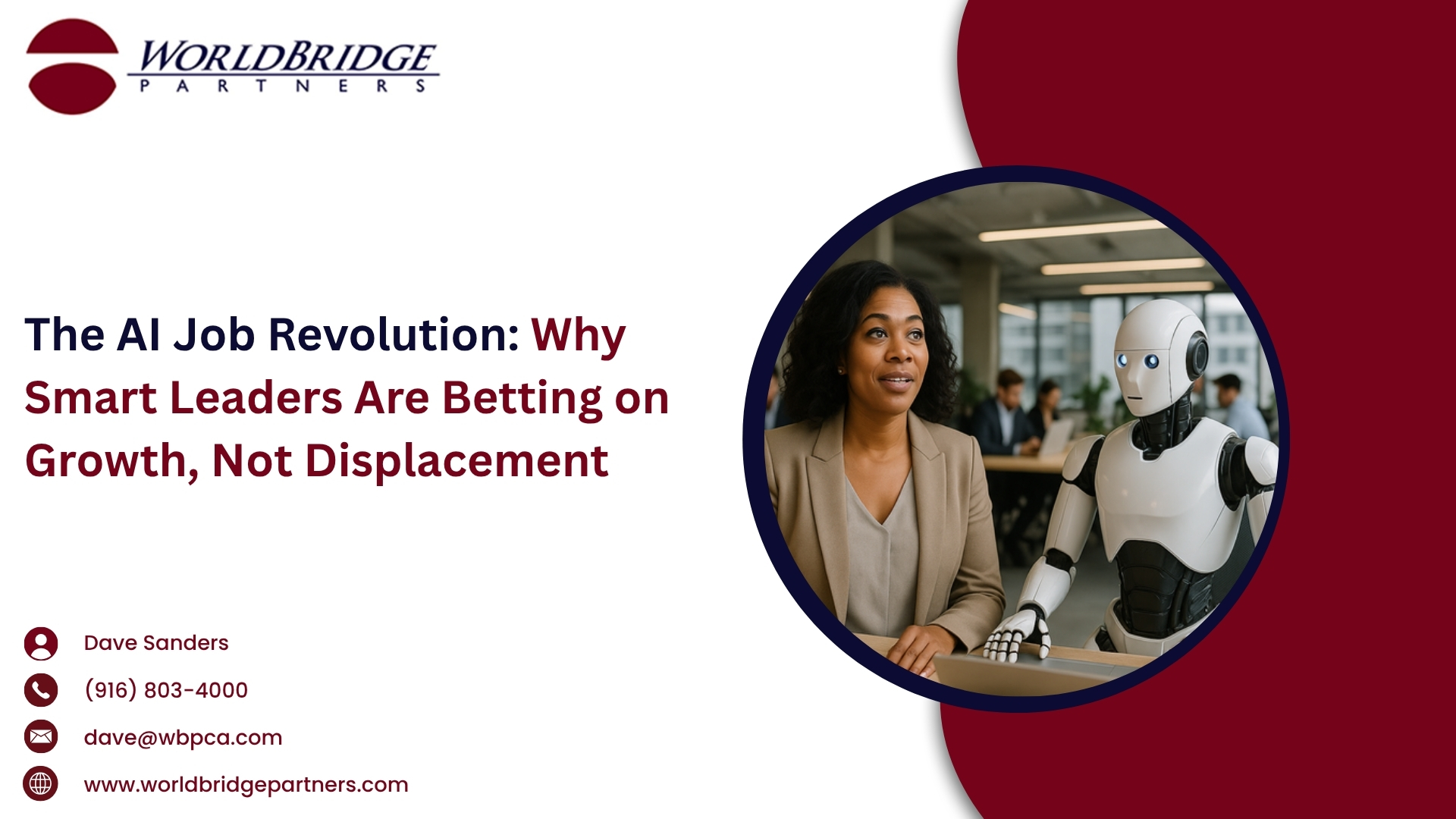
The AI Job Revolution: Why Smart Leaders Are Betting on Growth, Not Displacement
The headlines scream about AI eliminating jobs, but the data tells a completely different story—one that seasoned executives and investors have seen play out before. Having worked through multiple technology cycles, from the early days of enterprise computing to today’s AI revolution, the pattern is unmistakable: disruption creates more opportunities than it destroys.
History’s Lesson: Technology Multiplies Opportunity
Every major technological shift sparks the same fears. The spinning jenny displaced workers but ultimately triggered Britain’s economic transformation. Personal computers and the internet were supposed to eliminate entire professions—instead, they created over 19 million new jobs and entire industries we couldn’t have imagined.
Today’s AI revolution follows this same blueprint. The World Economic Forum projects 170 million new AI-related positions this decade against 92 million displaced—a net gain of nearly 80 million jobs. That’s not speculation; it’s based on observable trends already accelerating across every sector.
The Ground Truth: Demand Is Exploding
The executive search market reveals what’s really happening. Companies aren’t just looking for traditional roles anymore—they’re creating entirely new positions. Chief AI Officers, VP of AI Strategy, AI Ethics Directors, and Machine Learning Product Managers are becoming standard C-suite and senior leadership roles.
LinkedIn data shows AI job postings surged 59% since January 2024 alone. But it’s not just “AI jobs”—it’s every job evolving to include AI capabilities. Marketing leaders need to understand AI-generated content. Financial analysts must work with predictive models. Sales executives leverage AI for customer insights. HR professionals use AI for talent acquisition and retention strategies.
Where the Smart Money Is Moving
Venture capital flows reveal the true opportunity landscape. Investment isn’t concentrated in a few AI companies—it’s spreading across every industry as businesses integrate AI to serve customers better and operate more efficiently.
- Healthcare is seeing explosive growth in AI diagnostics, personalized treatment planning, and drug discovery. These aren’t replacing doctors—they’re creating new roles for medical AI specialists, clinical data scientists, and regulatory experts who understand AI medical devices.
- Financial Services is transforming through algorithmic trading, robo-advisory services, and AI-powered risk management. The demand for quantitative analysts, AI compliance officers, and machine learning engineers continues to outpace supply.
- Enterprise Software companies are building AI-first solutions, requiring product managers who understand large language models, customer success teams trained in AI implementation, and sales engineers who can demonstrate AI capabilities.
- Education Technology is exploding with adaptive learning platforms, creating needs for instructional designers, learning analytics experts, and AI tutoring specialists—roles that barely existed five years ago.
The Partnership Model Wins
The most successful companies aren’t replacing humans with AI—they’re creating powerful partnerships. AI handles data processing, pattern recognition, and routine analysis, while humans focus on strategy, creativity, relationship building, and ethical decision-making.
This isn’t about learning to code or becoming a data scientist. It’s about understanding how AI can amplify your existing expertise and free you to focus on higher-value activities that require uniquely human capabilities.
A marketing executive using AI content tools can focus more on strategy and creative direction. A financial analyst working with AI models can spend more time on interpretation and strategic recommendations. A sales leader leveraging AI insights can dedicate more energy to building relationships and closing complex deals.
Regional Opportunities Are Everywhere
The AI transformation isn’t limited to Silicon Valley. Secondary markets offer compelling advantages: lower costs, access to top-tier universities, and growing ecosystems of startups and established companies looking to expand.
Agricultural regions are seeing AI-powered farming solutions. Healthcare hubs are attracting medical AI companies. Financial centers are becoming hotbeds for fintech AI innovation. The geographic distribution of AI opportunities is broader than any previous technology wave.
Positioning for Success
Three strategies separate winners from those left behind:
- Embrace Continuous Learning: The professionals thriving through this transition view learning as a core competency. They’re not necessarily becoming AI experts, but they’re understanding how AI impacts their industry and role.
- Focus on Uniquely Human Skills: Creativity, emotional intelligence, ethical reasoning, and complex problem-solving become more valuable as AI handles routine tasks. These capabilities can’t be automated and are increasingly in demand.
- Think Like an Entrepreneur: New technologies create new problems to solve and new markets to serve. Whether through starting a company, innovating within an existing role, or identifying partnership opportunities, entrepreneurial thinking opens doors.
The Venture Capital Perspective
From an investment standpoint, AI represents the largest wealth and job creation opportunity in decades. Every industry is being reimagined, creating countless entrepreneurial opportunities for those willing to think differently about traditional business models.
The companies that will dominate aren’t just AI companies—they’re businesses successfully integrating AI to create new value propositions. This integration requires human talent at every level, from strategy to implementation to customer success.
A Call to Action
The AI revolution isn’t something happening to us—it’s something we can actively shape and benefit from. The organizations and professionals who recognize this shift as an opportunity rather than a threat will capture disproportionate value.
History shows that those who embrace technological change rather than resist it build the most successful careers and companies. The AI revolution is no different, except the opportunities may be larger than anything we’ve seen before.
The question isn’t whether AI will change how we work—it’s how quickly we can position ourselves to capitalize on the unprecedented opportunities ahead.
What opportunities are you seeing AI create in your industry? The patterns are clear, but the specific applications vary by sector. Share your observations—the collective wisdom of this community helps everyone navigate change more effectively.
#AI #FutureOfWork #Innovation #Leadership #TechRevolution #BusinessStrategy #Entrepreneurship #VentureCapital
Related Posts